 TraLand.com
Moon Lunation
The Moon’s phase, computed rather than looked up.
An offline Moon-phase app for iPhone, iPad and Mac. Today’s phase, a month calendar, and an animated walk through a single lunation — all solved on your device from the actual Sun–Earth–Moon geometry, with no network request of its own, ever.
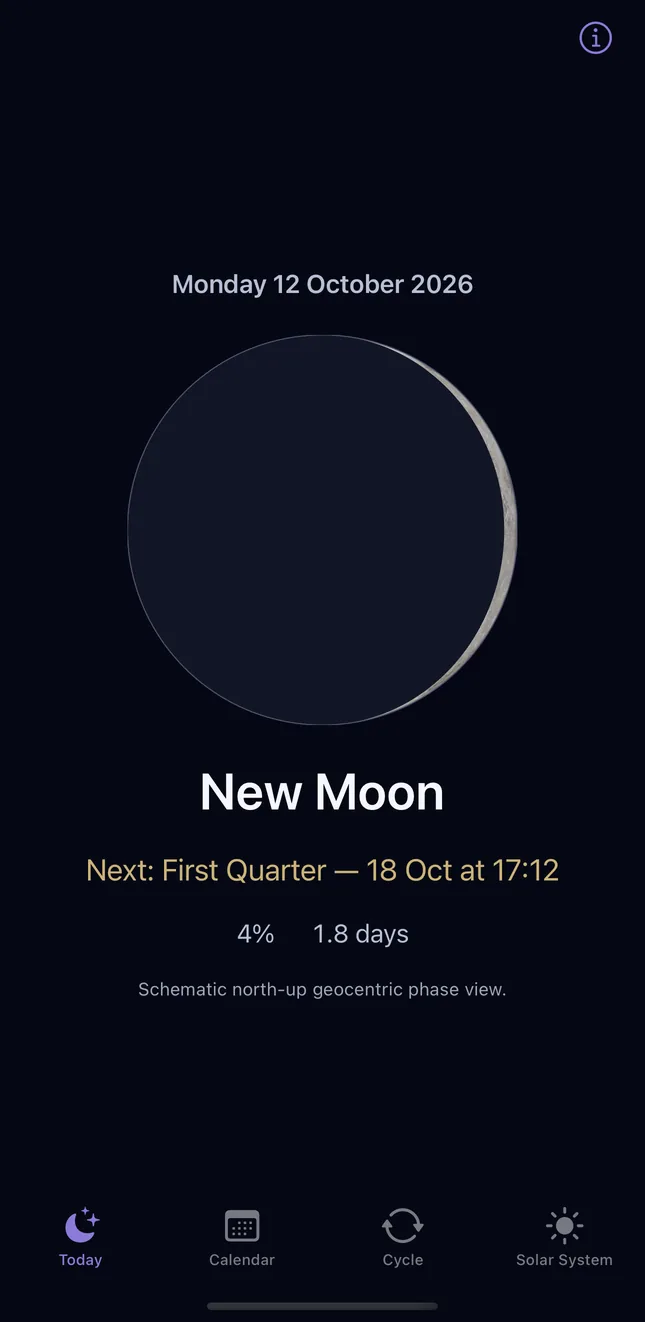
Today’s Moon, Monday 12 October 2026 (UK) — a capture of the app itself.
Schematic north-up geocentric phase view.
Three views of the same moving thing
Today’s phase, drawn from the geometry rather than picked from a set of eight icons. A month calendar you can move through. And a Cycle animation that walks a single lunation from new moon to new moon, so the shape you see is a continuous thing rather than a slideshow.
That Cycle interval runs between two actual consecutive computed new moons, so its length varies as the real thing does. It is not forced to the mean synodic month of 29.53 days.
Computed, offline, and honest about the picture
Three things that decide whether a Moon app is telling you something or showing you something.
Solved, not tabulated
The phase is computed by solving the actual geometry for the date you asked about. The implementation is validated against JPL DE440 reference fixtures, agreeing with them to within about 5e−13 degrees.
Nothing is fetched by the app
Every calculation happens on your device, including on first launch. There is no network request of its own, so it works the same on a plane as at home.
The image cannot lie to you
The Moon’s surface is clipped to the computed terminator. The picture follows the calculation — it cannot alter which phase is shown.
What changed, and what went away
If you owned the original Lunation, this is a different app under the same name. It arrives as an update, so please read what changed before you take it — including the feature that is gone.
- Phase times are computed, not read from a table.
- The old version read from a fixed table covering 2009–2010 and interpolated linearly between entries: it could not answer for a date outside that table, its in-between values approximated a curve, and it ran out years ago. This one solves the geometry.
- The city list and location features are gone.
- Entirely. There is no location permission and no city picker. Times are geocentric — see below.
- The Moon is no longer a 320-pixel frame.
- It is the NASA Scientific Visualization Studio CGI Moon Kit surface, built from Lunar Reconnaissance Orbiter data and reprojected offline into a fixed north-up near-side view.
- It covers 2000 to 2050, not 2009 to 2010.
- And outside that range it says so, rather than guessing.
What Moon Lunation is not
A Moon app can look authoritative while quietly answering a different question than the one you asked. These are the questions this one does not answer.
- It is not a picture of your sky.
- What you see is a schematic north-up geocentric phase diagram. The real Moon appears rotated by an amount that depends on where you are standing and when you look, and the app does not represent that rotation.
- It does not show libration.
- The Moon’s slight apparent wobble, which brings a little of the far limb in and out of view over a month, is neither calculated nor drawn.
- It does not predict eclipses.
- Phases come from Sun–Earth–Moon geometry; eclipses are a separate event that depends on Earth’s shadow. A full moon in this app is not a lunar eclipse forecast.
- Times are geocentric, not local.
- They are computed for the centre of the Earth rather than for your position. There is no location feature and no city list.
- No moonrise or moonset.
- Those are local, horizon-dependent events, and this app does not know where you are.
- It covers 1 January 2000 to 31 December 2050.
- Ask for a date outside that range and it tells you it cannot answer, rather than extrapolating something plausible.
Moon surface imagery: the public-domain CGI Moon Kit from NASA’s Scientific Visualization Studio, derived from Lunar Reconnaissance Orbiter data.
Credit: NASA’s Scientific Visualization Studio. NASA does not endorse this app.
Get Moon Lunation
On the App Store for iPhone, iPad and Mac — now free, with the 3D Solar System as a one-time in-app purchase. If you already own Moon Lunation, or owned the original 2009 Lunation, the update is free and the Solar System unlocks automatically.
Download on the App StoreiOS and iPadOS 17 or later, or macOS 14 or later. The Moon phase itself works entirely offline.